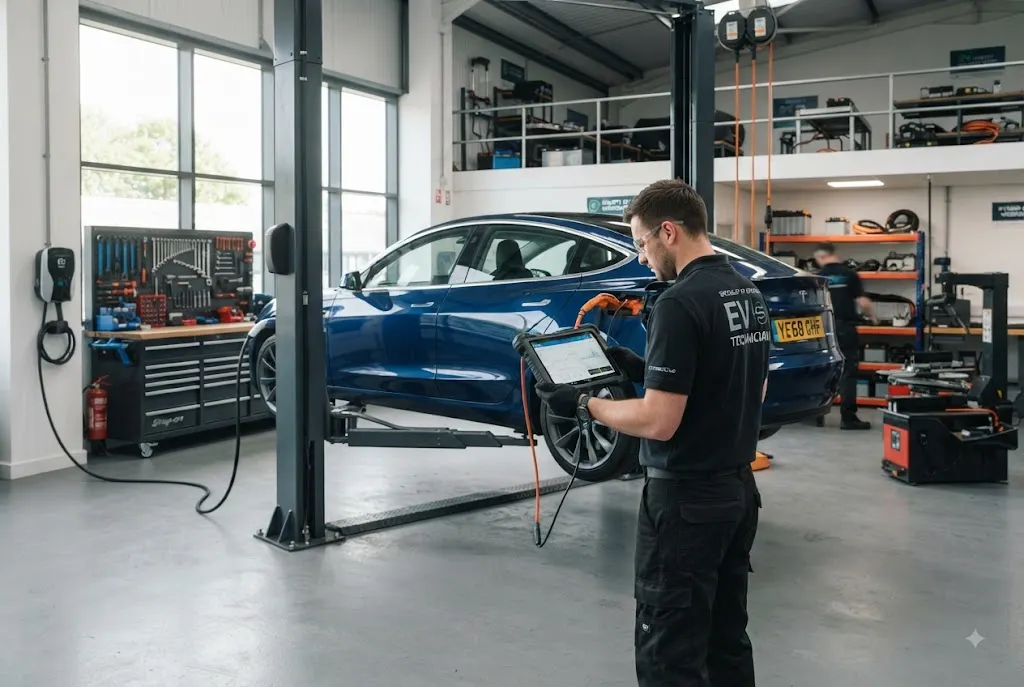
EV servicing is becoming an increasingly important part of vehicle ownership in the UK as more drivers move from petrol and diesel cars to fully electric vehicles. Although electric cars generally have fewer conventional mechanical components than vehicles with internal combustion engines, they still require regular inspection, maintenance and professional attention.
Electric vehicles rely on high-voltage battery systems, electric motors, power electronics, charging equipment, thermal management and conventional road-going components such as tyres, brakes, suspension and steering. As a result, EV maintenance is different rather than maintenance-free.
For owners, understanding what EV servicing involves can make it easier to choose a suitable workshop, recognise routine maintenance requirements and understand why some repairs require specialist training and equipment.
What Does EV Servicing Involve?
EV servicing covers the inspection and maintenance of an electric vehicle’s mechanical, electrical and electronic systems. The exact service requirements vary between manufacturers and models, so owners should follow the vehicle’s service schedule and handbook.
Unlike a conventional petrol or diesel vehicle, a fully electric car does not need routine engine oil changes, spark plug replacement or exhaust-system maintenance. However, that does not mean there is little to inspect.
Depending on the vehicle and manufacturer’s requirements, an EV service may involve checks of:
- High-voltage electrical systems
- Battery condition and related systems
- Electric motor and power electronics
- Charging equipment and connections
- Brake components
- Tyres and wheel condition
- Steering and suspension
- Cooling and thermal management systems
- Lights, wipers and other safety equipment
- Vehicle software and diagnostic systems
The focus is therefore on the systems that keep the vehicle safe, reliable and operating as intended rather than simply repeating the service checklist used for a conventional car.
Why EV Servicing Is Different
Electric vehicles contain high-voltage components that introduce additional considerations for repair and maintenance. The Health and Safety Executive explains that people working on electric and hybrid vehicles may need additional skills, knowledge, specialist tools and equipment. HSE guidance also notes that electric and hybrid vehicle voltages can be significantly higher than the 12V or 24V systems commonly found in conventional vehicles. :contentReference[oaicite:0]{index=0}
This distinction matters because not every automotive repair task is the same. Routine work such as tyre replacement may not require the same level of specialist intervention as work on a high-voltage battery or electrical system.
For vehicle owners, the practical takeaway is to choose a workshop that has the appropriate competence for the work being requested.
EV Battery Servicing and Battery Health
EV battery servicing is one of the subjects that creates the most questions for electric vehicle owners. The traction battery is central to an EV’s operation, so drivers naturally want to know how its condition is assessed and what happens when performance changes.
A battery is not simply treated like a conventional 12V car battery. An EV traction battery is a high-voltage energy-storage system integrated into the vehicle’s electrical architecture.
Depending on the vehicle and the issue being investigated, professional diagnostics may examine battery-related information, charging behaviour, fault codes, thermal management and other system data.
A warning message or change in driving range does not automatically mean that the complete battery pack needs replacing. Diagnosis should identify the underlying issue before repair decisions are made.
HSE guidance highlights that electric and hybrid vehicle batteries can store significant amounts of energy and that damaged or incorrectly handled systems can introduce additional hazards. :contentReference[oaicite:1]{index=1}
Why Battery Condition Matters
Battery condition can influence an EV’s usable range and overall ownership experience. However, battery performance should be considered alongside factors such as weather, driving style, vehicle load, speed and use of heating or cooling systems.
This is important when creating EV content because range-related concerns can easily become oversimplified. A responsible guide should distinguish between normal variation in range and a genuine battery or vehicle fault.
Electric Vehicle Maintenance Beyond the Battery
One of the most common misconceptions about electric cars is that they require very little maintenance. While they generally have fewer moving parts in the propulsion system, many conventional vehicle components remain important.
Tyres still need regular inspection. Steering and suspension components still experience normal road forces. Windscreen wipers, lights, washer fluid and other equipment still need attention.
Brakes also remain an important maintenance item. Electric vehicles can use regenerative braking, which allows some kinetic energy to be recovered during deceleration. Nevertheless, conventional friction braking components remain part of the vehicle’s safety system.
GOV.UK states that drivers are responsible for ensuring their vehicles remain safe to drive and advises regular checks of items including brakes, lights and tyres. The vehicle handbook should also be used to determine servicing intervals and other maintenance requirements. :contentReference[oaicite:2]{index=2}
EV Mechanics and Specialist Skills
EV mechanics need to understand more than conventional vehicle repair. The level of specialist knowledge required depends on the work being performed.
HSE separates work involving electric and hybrid vehicles into different categories, ranging from lower-risk activities to maintenance and repair and work directly on high-voltage electrical systems. The organisation states that the level of competence required depends on the type of work being undertaken. :contentReference[oaicite:3]{index=3}
This means a workshop can have experience working around electric vehicles without necessarily performing every type of high-voltage repair.
When selecting EV mechanics or an EV specialist, drivers should therefore consider whether the workshop has the appropriate training, equipment and experience for their particular vehicle and the work required.
Why Vehicle-Specific Information Matters
Electric vehicles do not all use identical battery layouts, electrical architectures or charging systems. HSE specifically highlights differences between electric and hybrid vehicle designs from different manufacturers and recommends access to information specific to the vehicle being worked on. :contentReference[oaicite:4]{index=4}
For this reason, a good EV service process should account for the specific model rather than relying solely on generic electric-car procedures.
Charging Systems and EV Maintenance
Charging systems form another important part of electric vehicle ownership. Drivers may charge at home, at workplaces, at public chargepoints or through other compatible infrastructure.
While a standard service does not necessarily involve inspecting every aspect of a home’s electrical installation, charging behaviour can be relevant when diagnosing an EV-related problem.
For example, a customer may report slow charging, interrupted charging or an error message. The problem could relate to the vehicle, charging cable, chargepoint, software or electrical supply. Proper diagnosis is therefore more useful than assuming that the vehicle battery is at fault.
UK Government guidance on EV chargepoints sets technical requirements for eligible installations and references standards including BS EN 61851 and BS 7671. :contentReference[oaicite:5]{index=5}
For drivers, this reinforces the importance of using compatible charging equipment and having electrical installation work performed appropriately.
EV Ownership and Routine Maintenance
EV ownership changes some aspects of routine vehicle care, but the fundamentals of responsible maintenance remain familiar.
Drivers should follow the manufacturer’s maintenance schedule and pay attention to warning messages or changes in vehicle behaviour. Regular tyre checks remain important, particularly because electric vehicles can be relatively heavy and can deliver strong torque immediately.
Brake components should also be monitored even when regenerative braking is used frequently. Other items such as suspension, steering, lights, wipers and windscreen condition should not be overlooked simply because the vehicle has an electric powertrain.
GOV.UK also reminds motorists that a current MOT certificate does not guarantee that a vehicle remains safe to drive. Roadworthiness is an ongoing responsibility. :contentReference[oaicite:6]{index=6}
When Should an EV Be Serviced?
There is no single universal EV servicing interval that applies to every electric vehicle. Manufacturers establish their own maintenance schedules based on the vehicle’s design, systems and intended operating conditions.
Some electric cars may have longer service intervals than comparable combustion-engine vehicles, while others require periodic inspections for specific systems.
The most reliable source is therefore the vehicle’s handbook, manufacturer’s servicing information or an authorised service provider familiar with the particular model.
Drivers should not wait for a dashboard warning before carrying out routine maintenance. Planned servicing is designed to identify issues before they develop into larger problems.
How EV Servicing Can Differ From Hybrid Servicing
EVs and hybrids share some electrical technology, but they should not be treated as identical vehicle types.
A hybrid typically combines an internal combustion engine with an electric propulsion system, whereas a fully electric vehicle relies on its battery and electric motor for propulsion. This means hybrid servicing can involve conventional engine-related maintenance alongside electric-system checks.
For a broader comparison, our guide to hybrid servicing explains how hybrid maintenance combines traditional vehicle systems with battery and electric-drive technology.
Keeping these topics separate is useful for both vehicle owners and automotive content strategies because the maintenance questions are related but not interchangeable.
What to Ask an EV Service Centre
Drivers who are unfamiliar with EV maintenance may find it useful to ask a few straightforward questions before booking a service.
- Does the workshop regularly work on electric vehicles?
- Does it have appropriately trained technicians for the required work?
- Can it carry out diagnostics on the particular vehicle?
- What does the proposed service include?
- Will any high-voltage system work be required?
- Are manufacturer-specific procedures being followed?
- Will the workshop explain any recommended repairs before carrying them out?
These questions can help distinguish between a workshop that simply accepts electric vehicles and one that has developed a genuine EV service capability.
EV Battery Servicing Requires Particular Care
Battery-related work deserves additional attention because high-voltage systems can remain dangerous even when a vehicle appears to be switched off.
HSE guidance explains that some components may retain dangerous voltages after isolation and that high-voltage systems should be isolated and proven dead before appropriate repair work is undertaken. It also emphasises the use of suitable tools, test equipment and vehicle-specific information. :contentReference[oaicite:7]{index=7}
For this reason, EV battery servicing should not be approached as a DIY task. Owners should leave high-voltage diagnosis, isolation and repair to appropriately competent professionals.
Creating Better EV Content for Drivers
For automotive service companies, EV content marketing provides an opportunity to address a rapidly changing customer knowledge gap.
Many drivers understand the basic idea of an electric vehicle but may still have questions about servicing, battery health, charging, tyres, brakes and long-term ownership. Useful content can answer these questions before customers arrive at a workshop.
A strong EV content strategy can include guides explaining routine maintenance, battery terminology, charging problems, warning lights, brake systems and differences between EVs and hybrid vehicles.
The content should remain practical rather than overly promotional. Drivers are more likely to find a guide useful when it explains what a particular issue means and when professional assistance may be appropriate.
This supports the wider approach discussed in automotive service companies and brand storytelling, where workshop expertise becomes part of the customer experience through clear and useful communication.
Building an EV Content Cluster
EV servicing works particularly well as a central topic within a broader automotive content cluster.
The main service page can explain what an EV service includes. Supporting articles can then explore EV battery servicing, charging systems, EV mechanics, tyre maintenance, regenerative braking and common electric vehicle ownership questions.
These pages can link naturally to one another while maintaining distinct search intent. A charging guide should focus on charging problems rather than repeating the entire EV servicing article. A battery article should concentrate on battery health and professional diagnostics rather than becoming another general maintenance guide.
This structure helps avoid keyword cannibalisation while allowing a website to build deeper topical coverage.
Why Accurate EV Content Matters
Electric vehicle technology is developing quickly, which makes accuracy particularly important for automotive publishers and service businesses.
Content should avoid universal claims about battery lifespan, servicing costs or maintenance intervals unless those claims are clearly supported and appropriately qualified. Different vehicles use different technologies, and manufacturer requirements can change.
For service businesses, the best approach is to explain what is known, identify where vehicle-specific information matters and direct customers towards appropriate professional assistance when the subject involves specialist electrical work.
Final Thoughts
EV servicing is different from traditional car maintenance, but it is not the same as having no maintenance requirements. Electric vehicles still depend on tyres, brakes, steering, suspension, cooling systems, charging equipment, electronics and other components that need appropriate inspection and care.
The biggest difference is the presence of high-voltage electrical systems and battery technology. Work involving these components requires appropriate skills, equipment and safety procedures, making the choice of workshop particularly important.
For UK drivers, the best approach is to follow the manufacturer’s maintenance schedule, pay attention to vehicle-specific guidance and use suitably competent professionals for specialist work. For automotive businesses, clear EV content can turn complex technology into useful customer education while building trust and demonstrating genuine expertise.