Reliable tyre services are an important part of keeping a vehicle safe, roadworthy and comfortable to drive. From fitting a new set of tyres to repairing suitable punctures, balancing wheels and checking tyre condition, professional tyre care covers much more than simply replacing worn rubber. For UK motorists, understanding these services can make it easier to recognise problems early, choose appropriate repairs and maintain tyres between garage visits.
Tyres are the only parts of a car that maintain direct contact with the road. Their condition can therefore influence braking, steering, acceleration and cornering. A good tyre service guide should explain what each service involves, when it may be required and why professional assessment matters.
What Do Tyre Services Include?
The term tyre services covers a range of workshop and maintenance tasks. The exact service a vehicle needs depends on tyre condition, mileage, driving habits, wheel condition and the manufacturer’s specifications.
Common services include:
- Tyre fitting and removal
- Tyre replacement
- Tyre repairs
- Wheel and tyre balancing
- Tyre pressure checks
- Tread-depth checks
- Visual inspections for cuts, bulges and other damage
- Tyre rotation where appropriate
- Checks following unusual vibration or handling problems
These services should not be treated as interchangeable. A punctured tyre, for example, may be repairable in some circumstances, while structural damage or unsuitable wear may mean replacement is the safer option.
Tyre Fitting: What Happens During the Process?
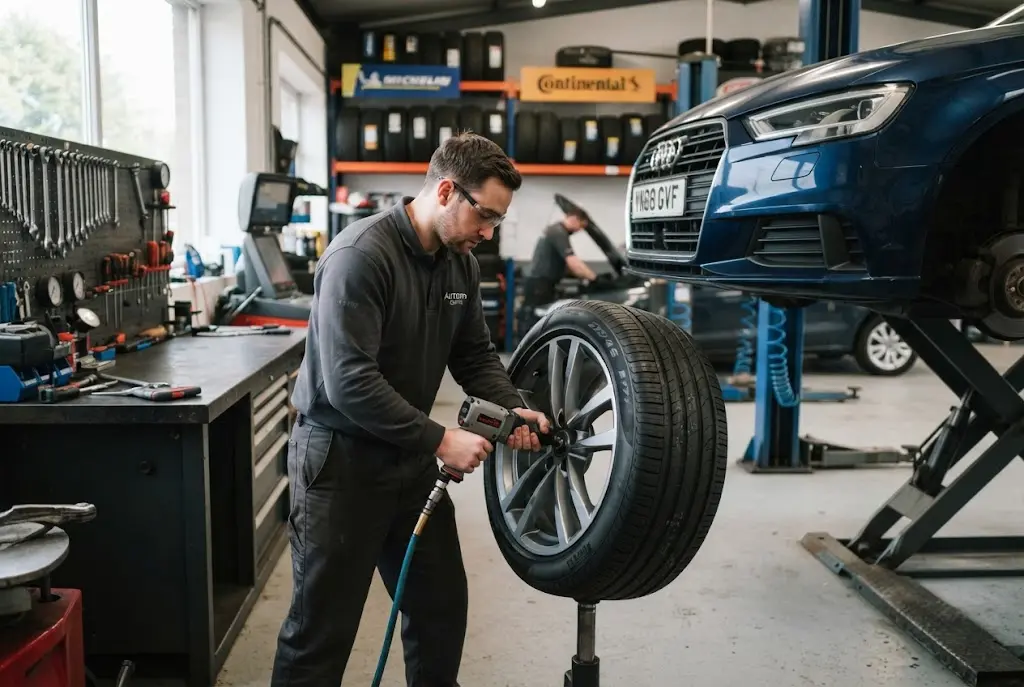
Tyre fitting involves removing the existing tyre from the wheel and installing the replacement correctly. Although changing a complete wheel may look straightforward, fitting a tyre to a wheel requires specialist equipment and appropriate procedures.
A professional fitting service will normally confirm the tyre size and specification before installation. The tyre must be compatible with the vehicle and wheel, and the fitting process needs to avoid damage to the tyre or rim.
Once the tyre is installed, the wheel may also require balancing. Correct wheel-nut torque is another important consideration when the complete wheel is refitted to the vehicle. Vehicle manufacturers specify the appropriate torque, so motorists should avoid relying on guesswork.
Professional fitting is particularly important when dealing with specialist tyres, run-flat designs, low-profile tyres or vehicles with tyre-pressure monitoring systems.
When Is Tyre Replacement Necessary?
Tyre replacement becomes necessary when a tyre is no longer suitable for safe road use or cannot be appropriately repaired. Low tread depth is one consideration, but it is not the only one.
Drivers should also pay attention to visible cuts, cracks, bulges, exposed cords, abnormal wear and other signs of damage. A tyre can have apparently reasonable tread while still having a condition that requires professional assessment.
For cars, light vans and light trailers in Great Britain, the legal minimum tread depth is 1.6mm across the central three-quarters of the tread and around the entire circumference. However, motorists should not treat the legal limit as a target for routine maintenance. Checking tyres before they approach an unsafe condition provides more opportunity to arrange a replacement.
Tyre choice also matters. Replacement tyres should match the vehicle’s required specification, including appropriate dimensions and load capability. The manufacturer’s recommendations should be consulted before changing tyre size or type.
Tyre Repairs: When Can a Tyre Be Repaired?
Tyre repairs can sometimes provide a suitable alternative to replacement, but not every puncture or damaged tyre can safely be repaired.
Professional assessment is essential because some damage may extend beyond what can be seen from the outside. TyreSafe advises that permanent repairs should only be carried out by a tyre specialist after the tyre has been removed from the wheel and inspected internally and externally.
Drivers should therefore be cautious about treating temporary sealants or externally applied plugs as permanent solutions. These products may help in an emergency, depending on the vehicle and manufacturer’s instructions, but they should not replace a proper professional inspection.
A tyre that has been driven while significantly under-inflated may also have internal damage that is not immediately obvious. In such cases, simply locating and sealing a puncture may not address the underlying safety issue.
Why Tyre Balancing Matters
Tyre balancing helps distribute the weight of a wheel and tyre assembly more evenly. When a wheel is out of balance, drivers may notice vibration through the steering wheel or vehicle, particularly at certain speeds.
Balancing is commonly carried out when new tyres are fitted or replaced. It can also be considered when a vehicle develops an unexplained vibration or after certain wheel-related work.
Correct balancing is not simply about improving comfort. Excessive vibration can make driving unpleasant and may contribute to uneven wear or additional stress on components. A professional workshop can use balancing equipment to identify and correct weight discrepancies in the wheel and tyre assembly.
Tyre Maintenance Should Be Part of Your Routine
Regular tyre maintenance is one of the simplest ways to identify developing problems before they become more serious. Drivers should make tyre checks part of their normal vehicle-care routine rather than waiting for a warning light or obvious handling problem.
TyreSafe recommends checking tyres at least monthly and before long journeys. Checks should include air pressure, tread depth and overall condition.
Check Tyre Pressure
Tyres should be inflated according to the vehicle manufacturer’s recommended pressures. The correct figures can normally be found in the vehicle handbook or on manufacturer information displayed on the vehicle.
Incorrect pressure can affect handling, tyre wear and vehicle efficiency. Pressure should also be considered when the vehicle is carrying a heavier load, following the manufacturer’s guidance.
Inspect the Tread
Tread depth should be checked across the appropriate parts of the tyre rather than relying only on appearance. Uneven wear can also provide useful clues about alignment, inflation or other vehicle issues.
Remember that the legal minimum and sensible maintenance threshold are not necessarily the same thing. A tyre approaching the legal limit deserves closer attention and may need replacement planning before it becomes an urgent problem.
Look for Visible Damage
Walk around the vehicle and look for cuts, cracks, bulges, objects embedded in the tread or other unusual damage. Sidewalls deserve particular attention because damage there can be more significant than a simple tread puncture.
If you notice a serious defect, avoid continuing to drive unnecessarily and seek professional advice.
How to Recognise When You Need a Tyre Service
Some tyre problems are obvious, while others appear through changes in the way a vehicle drives. Knowing the warning signs can help motorists seek assistance earlier.
- Persistent vibration through the steering wheel
- The vehicle pulling unexpectedly to one side
- Visible cuts, bulges or cracks
- Repeated loss of tyre pressure
- Uneven or unusual tread wear
- Reduced confidence when braking or cornering
- A tyre-pressure warning appearing on the dashboard
- A puncture or suspected impact damage
These symptoms do not always identify one specific fault. For example, vibration may relate to balancing, wheel condition, alignment or another component. That is why professional diagnosis is more useful than assuming that a tyre simply needs replacing.
Tyre Services and UK Road Safety Requirements
Tyre care is not only a matter of comfort or vehicle appearance. UK motorists have a responsibility to ensure that their vehicles are safe and roadworthy.
GOV.UK states that cars, light vans and light trailers must have at least 1.6mm of tread across the central three-quarters of the tread and around the entire circumference. Tyres must also be correctly inflated and free from certain cuts and defects.
Drivers should remember that a valid MOT does not remove their responsibility to keep the vehicle safe between tests. Tyre condition can change after an MOT because of mileage, impacts, pressure loss, weather and normal wear.
Choosing a Professional Tyre Service
When arranging tyre work, motorists should look for a service provider that can explain the work clearly rather than simply recommending replacement without assessment.
A reputable provider should be able to confirm the tyre specification, explain whether a repair is appropriate and identify any related wheel or tyre concerns. Clear communication is particularly useful when several options are available at different price points.
It is also sensible to ask what is included in the quoted service. Depending on the job, this may involve fitting, balancing, valve replacement, pressure adjustment or disposal of the old tyre.
For broader vehicle care, motorists can also explore our guide to the vital benefits of routine car maintenance. Understanding tyres as part of the wider maintenance schedule makes it easier to manage vehicle condition systematically.
Tyre Services for Different Driving Needs
Not every driver uses a vehicle in the same way. A car used mainly for short urban journeys may experience different patterns of wear from one regularly driven on motorways.
High-mileage motorists may need to pay particular attention to tread wear and pressure. Drivers who regularly carry heavy loads should follow the manufacturer’s recommendations for pressures and load ratings. Vehicles used seasonally may also need additional checks after extended periods of storage.
The right approach is therefore to combine manufacturer guidance with regular visual inspections and professional advice when something appears unusual.
Why Good Tyre Care Can Prevent Bigger Problems
Regular tyre checks can help identify issues before they develop into more expensive or disruptive problems. A gradual pressure loss, for instance, may indicate a puncture, valve issue or another fault that deserves attention.
Likewise, uneven tread wear may provide an early indication that something elsewhere in the wheel or suspension system needs checking. Addressing these warning signs promptly can make vehicle maintenance more predictable.
Good tyre care also supports better preparation for long journeys. Before travelling, drivers should check pressures, tread and visible condition rather than assuming that tyres are fine because the vehicle has recently passed an MOT.
Tyre Services: A Practical Maintenance Approach
Effective tyre care does not need to be complicated. A simple routine can make a significant difference: check tyre pressures regularly, inspect the tread and sidewalls, respond promptly to warning signs and use a qualified tyre specialist for fitting and repairs.
When a tyre reaches the end of its useful life, replacement should be based on its overall condition and the vehicle manufacturer’s requirements. If damage occurs, professional assessment should determine whether repair is appropriate.
Ultimately, tyre services work best as part of a wider vehicle maintenance strategy. Fitting, replacement, repairs, balancing and routine checks each have a role, and understanding those roles helps UK drivers make safer and better-informed decisions about their vehicles.
For more vehicle-related guidance, browse the Auto Services section for practical articles covering routine maintenance and other automotive topics.