Wheel alignment is an important part of vehicle maintenance because the position of a vehicle’s wheels affects steering, tyre wear and how the car behaves on the road. When alignment is outside the manufacturer’s specified geometry, drivers may notice symptoms such as uneven tyre wear, a vehicle pulling to one side or a steering wheel that does not sit correctly when travelling straight.
Despite being a common workshop service, wheel alignment is often confused with wheel balancing and wheel tracking. These terms are related to wheels and tyres, but they describe different procedures. Understanding the difference can help UK drivers identify potential problems and choose the right service when maintenance is required.
This guide explains what alignment means, common terminology, warning signs, the relationship with steering and tyres, and how alignment checks fit into a wider vehicle maintenance programme.
What Is Wheel Alignment?
Wheel alignment is the process of checking and, where appropriate, adjusting the geometry of a vehicle’s wheels and steering components so they correspond with the manufacturer’s specifications.
Modern alignment equipment can measure the position and angles of individual wheels. Depending on the vehicle, technicians may assess measurements associated with camber, caster and toe, alongside other geometry values relevant to the particular suspension design.
The aim is not simply to make all four wheels point in exactly the same direction. Vehicle manufacturers specify geometry based on the vehicle’s suspension, steering and handling characteristics.
Correct alignment can help the vehicle track as intended, support even tyre wear and contribute to predictable steering behaviour. However, an alignment check cannot repair worn or damaged suspension and steering components. If an underlying mechanical fault is present, that issue may need to be addressed before an accurate alignment can be completed.
Why Wheel Alignment Matters
Wheel alignment matters because wheels and suspension operate as part of a connected system. A change in geometry can affect how a tyre contacts the road and how the vehicle responds to steering inputs.
The Highway Code’s vehicle maintenance guidance specifically notes that excessive or uneven tyre wear can be caused by faults in braking or suspension systems, or by wheels being out of alignment. It advises that such faults should be corrected as soon as possible. :contentReference[oaicite:0]{index=0}
Alignment is therefore not just about improving the feel of a car. It can be part of diagnosing a wider vehicle condition.
For example, if a driver reports that the car pulls to one side, a technician may need to consider tyre pressures, tyre condition, steering components, suspension and alignment rather than immediately assuming that an alignment adjustment alone will solve the problem.
Common Signs You May Need Wheel Alignment
There are several symptoms that can justify having the vehicle’s wheel geometry checked. None of these signs automatically proves that the alignment is incorrect, but they can indicate that further inspection is worthwhile.
Uneven Tyre Wear
Uneven wear across a tyre can be associated with alignment problems, although it can also have other causes. Incorrect tyre pressures, suspension faults and other mechanical conditions may contribute to unusual wear patterns.
If one part of a tyre is wearing significantly faster than another, a professional inspection can help identify the cause rather than simply replacing the tyre.
The Vehicle Pulls to One Side
A car that consistently moves towards one side when the driver is attempting to travel straight may require investigation.
However, pulling is not necessarily caused by alignment. Tyre pressures, road surface characteristics, tyre condition and steering or suspension problems can also influence vehicle behaviour.
GOV.UK advises drivers that if a vehicle pulls to one side when braking, it is most likely to indicate a brake fault or incorrectly inflated tyres and recommends consulting a garage or mechanic immediately. :contentReference[oaicite:1]{index=1}
The Steering Wheel Appears Off-Centre
If the steering wheel appears noticeably off-centre while the vehicle is travelling straight, it may be worth having the steering and alignment inspected.
Again, the correct approach is diagnosis rather than assuming that an alignment adjustment is automatically required. A technician should establish whether the steering system, suspension, tyres or wheel geometry is responsible.
Unusual Tyre Wear After a Pothole
Impacts from potholes, kerbs and other road hazards can affect wheels, tyres, steering or suspension components. A vehicle that develops new symptoms after a significant impact may benefit from a professional inspection.
An alignment measurement can reveal whether wheel geometry has changed, while a physical inspection can identify damage that an alignment machine alone cannot diagnose.
Wheel Alignment vs Wheel Balancing
Wheel alignment and wheel balancing are different services, even though both can affect how a vehicle feels while driving.
The Wheel balancing addresses the distribution of weight around a wheel and tyre assembly. A technician uses balancing equipment to identify an imbalance and may add appropriate weights to correct it.
Wheel alignment, by contrast, concerns wheel and suspension geometry. It deals with the position and angles of the wheels relative to the vehicle and the manufacturer’s specifications.
This distinction is important because different symptoms can point towards different areas of investigation. Vibration at certain speeds may lead a technician to investigate wheel balance, tyre condition or wheel condition, whereas uneven tyre wear or steering-related symptoms may lead to an alignment assessment.
In some cases, a vehicle may require both services, but one does not replace the other.
Wheel Tracking and Alignment Terminology
Wheel tracking is a term commonly used by garages and motorists, particularly when discussing front-wheel geometry. In everyday automotive language, it is often used to describe checking or adjusting wheel alignment.
However, automotive terminology can vary between businesses, which is why customers should ask what a particular service actually includes.
A modern alignment service may involve measuring multiple geometry angles across the vehicle rather than simply adjusting the front wheels.
Understanding alignment terminology can make conversations with a garage easier. Customers do not need to become suspension experts, but knowing that alignment, balancing and tracking can refer to different procedures helps avoid confusion.
Toe
Toe describes the direction in which the wheels point when viewed from above. The wheels may be set slightly inward or outward according to the manufacturer’s specification.
Camber
Camber refers to the inward or outward tilt of a wheel when viewed from the front or rear of the vehicle.
Caster
Caster relates to the steering axis angle when viewed from the side. It can influence steering characteristics and the vehicle’s tendency to return towards a straight-ahead position.
Not every vehicle allows every alignment angle to be adjusted. The available adjustments depend on the vehicle’s design and the condition of its components.
When Should You Get an Alignment Check?
There is no universal interval that means every UK car requires a wheel alignment adjustment after a fixed number of miles. Whether an alignment check is appropriate depends on the vehicle, its condition, symptoms and the manufacturer’s recommendations.
An inspection may be particularly sensible after a significant pothole or kerb impact, when unusual tyre wear appears, when steering behaviour changes or when suspension or steering components have been replaced.
It can also make sense to investigate alignment when fitting new tyres if the old tyres show unusual or uneven wear. Identifying the cause of the wear can help prevent a new set of tyres from developing the same problem.
GOV.UK recommends regular vehicle checks and states that drivers are responsible for ensuring their vehicles remain safe and roadworthy. It also advises motorists to follow their vehicle handbook for servicing requirements and tyre maintenance. :contentReference[oaicite:2]{index=2}
Wheel Alignment After Suspension or Steering Repairs
Changes to suspension or steering components can affect wheel geometry. This is why alignment may be relevant after certain repairs.
The exact requirement depends on which component has been replaced and how the vehicle’s geometry is affected. A competent workshop should assess whether an alignment check or adjustment is appropriate rather than automatically treating every repair as identical.
This becomes particularly important on vehicles equipped with advanced driver assistance systems. DVSA guidance for commercial vehicles notes that ADAS cameras and sensors may require checking or calibration after wheel alignment geometry adjustments or mechanical repairs affecting vehicle geometry. :contentReference[oaicite:3]{index=3}
The principle demonstrates how modern vehicle maintenance is increasingly interconnected. Wheel geometry can affect more than tyre wear and steering feel on vehicles that rely on cameras, sensors and electronic assistance systems.
How Wheel Alignment Is Checked
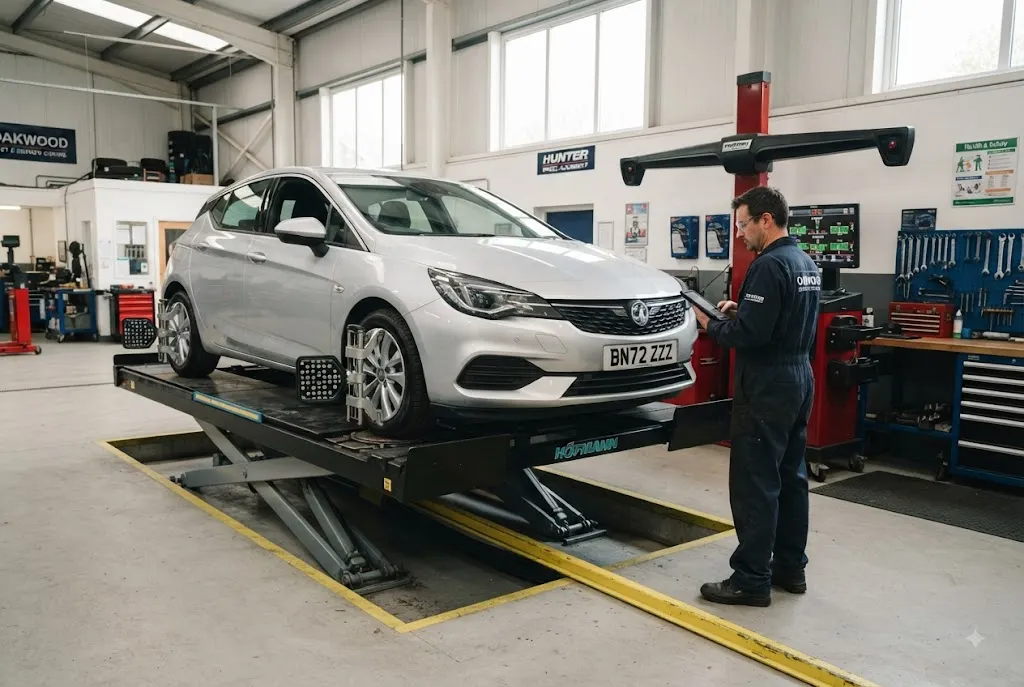
A professional alignment check generally involves mounting the vehicle on appropriate equipment and measuring the wheel geometry.
Depending on the system and vehicle, sensors or targets may be attached to the wheels so that the alignment machine can compare measurements with specified values.
The technician may then determine whether adjustments are required. Before making adjustments, the workshop should also consider the physical condition of relevant steering, suspension, wheel and tyre components.
If a suspension arm, steering component or other part is worn or damaged, correcting alignment readings without addressing the underlying issue may not provide a lasting solution.
Why Tyres and Alignment Should Be Considered Together
Tyres are the only part of the vehicle designed to maintain continuous contact with the road, making their condition particularly important.
Incorrect alignment can contribute to uneven wear, while incorrect tyre pressure can also affect handling and wear. The Highway Code advises motorists to check tyre pressures and highlights the relationship between tyre condition, steering and braking. :contentReference[oaicite:4]{index=4}
That means an alignment discussion should rarely be completely separated from tyre maintenance.
For example, replacing two badly worn tyres without investigating why they wore unevenly could leave the underlying problem unresolved. Conversely, assuming that unusual tyre wear is caused by alignment without checking tyre pressure and suspension condition could lead to the wrong repair.
Wheel Alignment and Electric Vehicles
Wheel alignment is relevant to electric vehicles as well as petrol and diesel cars. The propulsion system does not remove the need for correct wheel geometry, tyre maintenance or steering inspection.
Electric vehicles can also have substantial battery weight and different handling characteristics, making appropriate tyre and suspension maintenance important throughout ownership.
Drivers researching EV maintenance can read our guide to EV servicing for a broader explanation of electric vehicle maintenance and specialist workshop requirements.
Wheel Alignment and Hybrid Vehicles
Hybrid vehicles also require the same fundamental attention to tyres, steering and suspension as other passenger cars. Their hybrid powertrain does not make alignment unnecessary.
For drivers exploring maintenance requirements for hybrid cars, our guide to hybrid servicing explains how conventional mechanical maintenance fits alongside hybrid-specific systems.
This illustrates an important point for modern vehicle owners: advanced powertrain technology changes some maintenance procedures, but basic road contact, steering and suspension requirements remain essential.
Creating Better Wheel Alignment Content
For automotive service companies, wheel alignment is a useful subject for educational content because customers frequently encounter unfamiliar terminology.
A strong maintenance guide should explain the difference between alignment, balancing and tracking without making unsupported promises. It should also explain common symptoms and encourage professional inspection where appropriate.
Rather than publishing several articles that repeat the phrase wheel alignment, a content strategy can separate the subject into useful supporting topics. One article can explain alignment terminology. Another can cover uneven tyre wear. A separate guide can discuss wheel balancing and vibration. Additional content can address steering symptoms and maintenance after suspension repairs.
This creates a stronger editorial structure and helps users find information that matches their specific question.
How Garage Businesses Can Explain Alignment Clearly
Garage chains and independent workshops can make alignment services easier to understand by explaining exactly what customers receive.
A service page might describe the measurement process, the types of geometry assessed, when adjustments may be recommended and why worn components may need attention first.
Clear communication is particularly valuable when a customer arrives with a symptom rather than a confirmed diagnosis. A driver does not necessarily need to know whether the issue is toe, camber, caster or suspension wear. The workshop’s role is to investigate the symptom and explain the findings clearly.
This approach supports the wider principles discussed in automotive service companies and customer-focused brand storytelling. Technical expertise becomes more valuable when customers can understand what has been found and why a particular recommendation has been made.
What Drivers Should Ask a Garage
If a garage recommends an alignment service, customers can ask a few straightforward questions:
- What symptoms or measurements indicate an alignment issue?
- Will the vehicle be inspected for worn steering or suspension components?
- Which alignment measurements will be checked?
- Does the service include adjustment if required?
- Will I receive measurement results?
- Could the tyre wear have another cause?
These questions do not require technical expertise. They simply encourage a clear explanation of the work being recommended.
Final Thoughts
Wheel alignment is an important part of understanding how tyres, steering and suspension work together. Incorrect geometry can contribute to uneven tyre wear and changes in vehicle behaviour, but alignment is only one possible cause of these symptoms.
Wheel balancing and wheel tracking are also commonly discussed alongside alignment, yet they should not be treated as interchangeable terms. A proper diagnosis considers the vehicle’s tyres, wheels, steering, suspension and alignment geometry together.
For UK drivers, regular vehicle checks, appropriate tyre maintenance and prompt investigation of unusual handling or wear can help identify problems before they become more serious. For automotive service companies, clear educational content can make technical subjects easier to understand while building trust and demonstrating workshop expertise.
The most useful wheel alignment content does not simply tell motorists to book a service. It explains what alignment means, what symptoms may justify an inspection and why the underlying cause needs to be identified. That combination of education and practical guidance creates a stronger resource for drivers and a more authoritative automotive content strategy.